
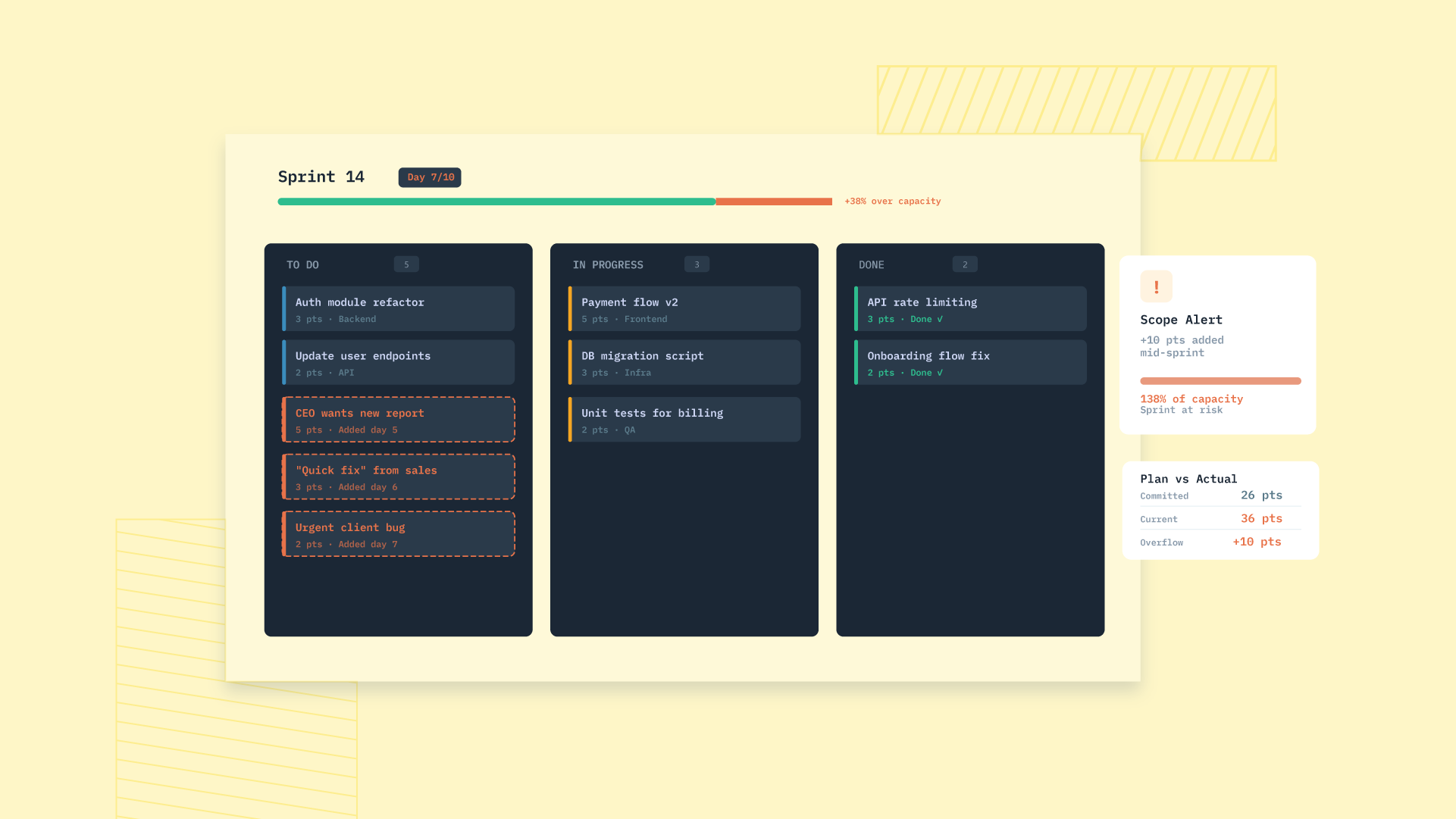
Scope creep rarely arrives as a big request. It usually enters through a story that grows, an urgent task added halfway through the sprint, or a dependency that turns out to be larger than planned. If nobody makes the trade-off visible, the sprint absorbs the work and the team appears to have missed its commitment.
This guide explains the scope creep meaning in an Agile context, the signals that expose it early, and how to manage scope creep in Agile without turning process data into blame.
Scope creep: key takeaways
- Scope creep is added work after commitment. In Agile, it often appears as expanding stories or new work entering a sprint without a clear trade-off.
- Early signals are observable. A rising burndown, repeated re-estimation, growing work in progress, and more unplanned work show that the plan changed.
- A repeatable response protects the sprint. Detect the change, estimate its impact, decide on the trade-off, and communicate the decision.
- Change can be valuable. The problem is invisible, unmanaged change that the team never chose deliberately.
What is scope creep in Agile?
Scope creep is work added to a sprint, epic, or release after the team has committed to it. In Scrum, it can show up when a story quietly grows beyond its original size or a new task enters the sprint backlog without a discussion of what it displaces.
A sprint is a fixed timebox with a sprint goal and a selected backlog. The Scrum Guide describes those boundaries, while teams decide how to handle new information inside them. Scope creep is a process signal to investigate, not a reason to fault an individual.
Treating it as a signal changes the conversation. Instead of asking why someone failed to deliver, you can ask what changed, when it changed, and whether the team agreed on the consequence.
Why scope creep hurts more in Agile sprints
Scope creep hurts a sprint because every unplanned addition consumes capacity that was already committed. If the team accepts more work, something must move: the release date, the scope, the available capacity, or the original commitment.
When that trade-off stays hidden, estimates lose credibility and the board stops representing reality. The team can work hard and still look as though it underdelivered because stakeholders are comparing completed work with an outdated plan.
Visible trade-offs protect team trust too. They give a product owner, engineering lead, and delivery team a shared basis for deciding whether a new request is worth changing the sprint goal.
Common causes of scope creep
Scope creep usually comes from a small set of sources. Naming the source helps you choose the right response instead of treating every addition as the same problem.
- Unclear initial scope. A story grows when the acceptance criteria or definition of done did not capture the real work.
- Shifting priorities. A customer escalation, market change, or stakeholder request can change what matters after planning.
- Feedback during delivery. Useful user feedback can reveal a gap that is worth addressing before release.
- Unexpected dependencies. A technical constraint or another team's delay can uncover work that was unknown during refinement.
Some causes point to a planning improvement. Others justify a deliberate change in direction. Planning accuracy gives you a way to review whether the gap between commitment and delivery is becoming a recurring pattern.
Early warning signs of scope creep
Scope creep is detectable before sprint review when the team watches a few concrete signals. The goal is to surface a change within a day or two, while the team can still choose a response.
A flat or rising burndown
A burndown that flattens or rises mid-sprint is a clear visual signal that work was added or progress stalled. When scope changes, the remaining-work line can step upward even as the team is delivering; when a team is simply behind, the line usually falls too slowly without jumping higher.
Review the burndown in each standup. Our guide to using a burndown chart explains how the shape can reveal a scope change before the sprint closes.
Stories that keep being re-estimated
Repeated re-estimation usually means the original sizing missed complexity. It can signal unclear requirements, a hidden dependency, or a story that is being expanded during delivery.
Re-estimation is useful when it prompts an explicit decision. Pair it with issue cycle time to see whether the work is also spending longer in progress than similar items.
Growing work in progress
Work in progress grows when more tasks open without a matching flow of completed tasks. Added requests can create this pattern because the team starts new work before finishing the work already in flight.
A rising WIP count does not prove scope creep on its own. It is a prompt to look at the board, identify what entered the sprint, and decide whether the team should finish, defer, or replace work.
Unplanned work taking a larger share of the sprint
Unplanned work rising as a share of committed work is the quantified version of “we keep getting pulled onto other things.” It turns a general sense of interruption into a trend the team can discuss across sprints.
Track the ratio over time rather than reacting to one spike. For response tactics, see how to deal with unplanned work in software development.
How to detect scope creep early with the right metrics
You cannot manage scope creep you cannot see. Map each warning sign to a view that exposes it, then use the result to inform a decision with the team.
| Warning sign | Metric or view | Decision it informs |
|---|---|---|
| Work added mid-sprint | Sprint scope change view | Accept the addition or defer it |
| Flat or rising burndown | Daily sprint burndown | Rebalance work or escalate the risk |
| Unplanned work increasing | Unplanned-work ratio over time | Improve planning for the next sprint |
| Stories repeatedly re-estimated | Issue cycle time and re-estimation history | Refine the work or address hidden complexity |
A sprints view makes the commitment and current work visible together. Read it with cycle time and planning signals so the team can distinguish added scope from a bottleneck that was already present.
How to manage scope creep in Agile
Managing scope creep in Agile is a repeatable loop: detect the change, estimate its impact, decide on the trade-off, and communicate the decision. This turns “just add this” into a choice the team makes with evidence.
- Detect the change early. Raise new work in the standup or as soon as it appears on the board. The earlier the team sees it, the more options remain.
- Estimate its impact. Size the work and show what it displaces. Make the cost visible in release timing, scope, or capacity.
- Decide the trade-off with the product owner. Keep all three levers on the table. The right choice may be to accept, replace, defer, or split the work.
- Communicate the decision to the whole team. Update the board and explain what changed. Shared visibility prevents silent additions from compounding.
The process does not prescribe an automatic yes or no. It gives the people responsible for delivery a common picture for choosing deliberately.
Estimate the impact before accepting the change
Before new work enters a sprint, size it and show which planned work it affects. This makes a request for added scope a visible decision about date, scope, or capacity.
Bring the estimate to the next standup when possible. The team then sees the cost together, including the work that may need to move, rather than leaving one person to absorb the request privately.
Decide the trade-off with the product owner
Scope decisions belong with the product owner and the delivery team. They need to weigh the value of the request against the sprint goal, current capacity, and the work that would be delayed.
Clear metrics help explain that decision beyond engineering. The approach in agile metrics can help you frame delivery signals as decisions for stakeholders rather than as activity scores.
Communicate the change to the whole team
Once the team decides, make the addition and its reason visible on the board. Silent scope change damages trust because people feel the extra work while the plan continues to imply that nothing changed.
Use standups and retrospectives to discuss the pattern. A continuous improvement strategy gives teams a practical rhythm for turning those observations into a small process experiment.
How to prevent scope creep before the sprint starts
Most scope creep is prevented during planning. Better preparation reduces unmanaged change, though no planning process removes the need to react to new information.
- Set a clear definition of done. Clarify what finished means before work begins.
- Use well-sized stories. Small, understood stories are less likely to expand unexpectedly.
- Keep a groomed backlog. Refine dependencies, acceptance criteria, and priorities before committing.
- Agree on a change process. Make it clear how new requests will be evaluated during a sprint.
- Review recurring patterns. If the same source keeps entering mid-sprint, address it in planning rather than absorbing it repeatedly.
Prevention aims for fewer surprises, not zero change. A healthy team still has room to respond to a real customer need or production issue.
When scope creep is actually a good thing
Some scope change is the right decision. New customer information, a critical incident, or an important discovery can make an addition more valuable than the original plan.
The useful distinction is whether the change is managed and visible. If the product owner and team choose to add work while acknowledging what moves, they are adapting to evidence. If work accumulates without that choice, the sprint becomes difficult to forecast and explain.
Detecting scope creep early with DevStats
Watching every board and recalculating scope change manually takes attention away from delivery. DevStats is an engineering intelligence platform that connects existing Git and issue tools, bringing sprint progress, unplanned work, and scope-change signals into one view.
The framing is diagnostic. DevStats can show where scope shifted and where the sprint is at risk, while the team decides whether to adjust the plan. The focus stays on process-level signals, never individual blame.
Catch scope creep before it costs you a sprint
Scope creep costs a sprint when it remains invisible until the review. Connect your existing tools and use DevStats to see live sprint progress and unplanned work while there is still time to decide on the trade-off.
Explore DevStats pricing to find the right plan for your team.
Frequently asked questions
What is scope creep in Agile?
Scope creep in Agile is work added after a team has committed to a sprint, epic, or release. It often appears as stories expanding or new work entering mid-sprint without a visible trade-off.
How do you detect scope creep early?
Watch for a flat or rising burndown, repeated re-estimation, growing work in progress, and unplanned work taking a larger share of the sprint. Review those signals in the standup so changes surface before sprint close.
How do you manage scope creep in a sprint?
Detect the change, estimate its impact, decide with the product owner what will move, and communicate the result to the team. The process makes the trade-off explicit instead of silently absorbing added work.
Is scope creep always bad?
No. New information can make a scope change worthwhile. The risk is unmanaged change that nobody has chosen or accounted for in the sprint plan.