
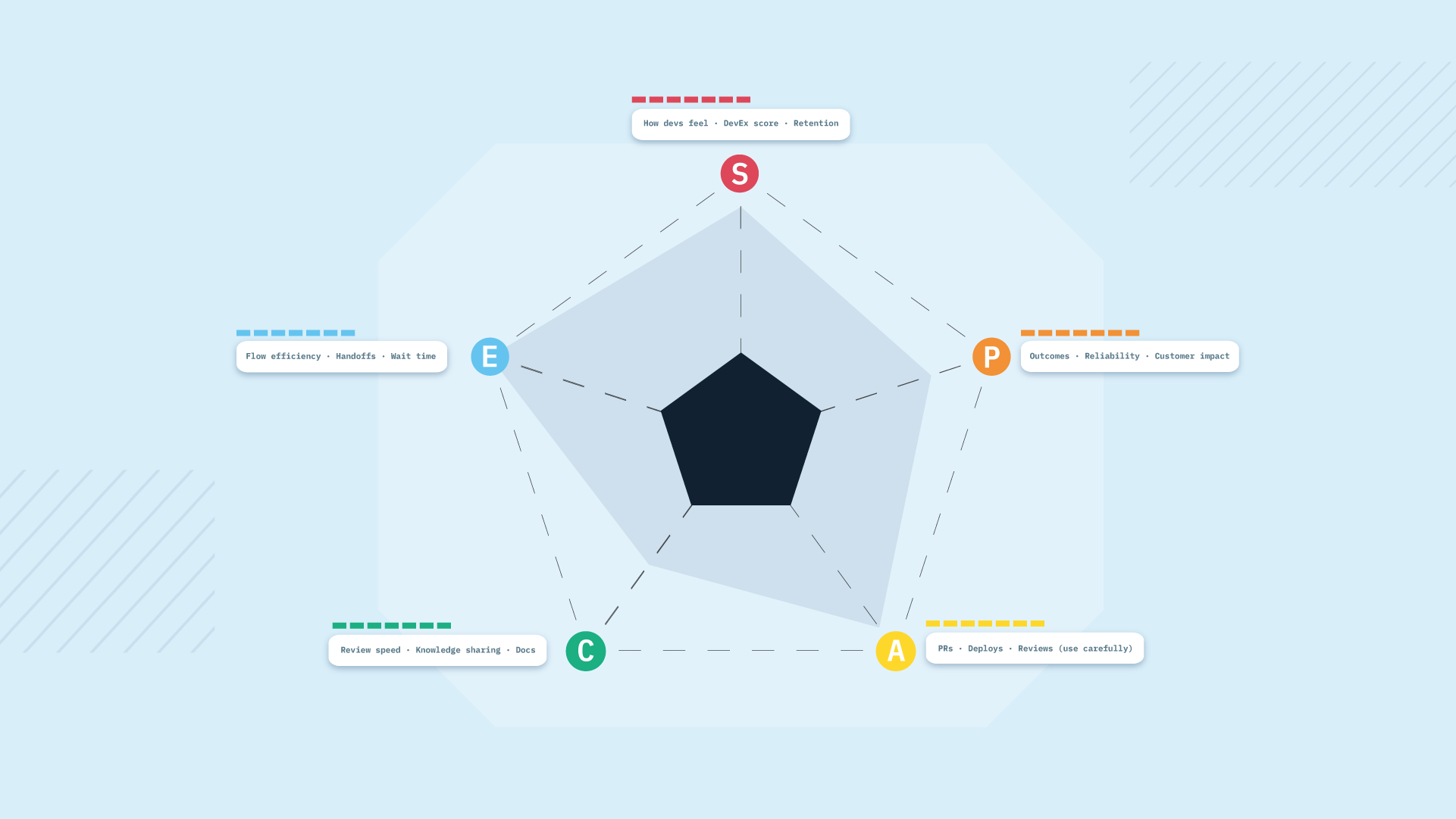
Developer productivity is not a single number. The SPACE framework gives engineering leaders a practical way to measure it across five dimensions: satisfaction and well-being, performance, activity, communication and collaboration, and efficiency and flow.
Developed by researchers from Microsoft Research, GitHub, and the University of Victoria, SPACE helps you understand how your engineering system is working without reducing people to commit counts or lines of code. The point is to measure processes, not people.
What is the SPACE framework?
The SPACE framework is a multidimensional model for developer productivity introduced in the 2021 ACM Queue paper, The SPACE of Developer Productivity. It recognizes that software work is collaborative, and that a single output metric cannot describe whether a team is effective or healthy.
SPACE stands for:
- Satisfaction and well-being: How developers feel about their work, tools, and sustainability.
- Performance: The outcomes, quality, and value created by the team.
- Activity: The volume and type of work completed, interpreted carefully.
- Communication and collaboration: How effectively people coordinate, share knowledge, and review work.
- Efficiency and flow: How smoothly work moves through the system with minimal interruption and waiting.
The framework's core recommendation is to use measures from at least three dimensions. That balance makes it much harder for one attractive number to hide a cost somewhere else.
Why single productivity metrics fail
A metric can be accurate and still lead you to the wrong decision. Commit counts, lines of code, tickets closed, and story points describe activity, but they do not tell you whether customers received value, whether quality held up, or whether the team can sustain its pace.
Consider a squad that increases merged pull requests by 30%. That can look like progress until you find longer PR cycle time, rising rework, and more after-hours work. The team may be moving faster only because it is carrying more risk.
The same problem appears when individual metrics become targets. Engineers begin optimizing for a visible score instead of the shared outcome. The data loses its diagnostic value, and trust in the measurement program goes with it.
The five dimensions of SPACE
SPACE asks you to read developer productivity as a system. Each dimension surfaces a different part of the picture.
Satisfaction and well-being
Satisfaction covers whether developers feel supported, engaged, and able to do good work. Surveys, retention trends, and qualitative feedback are the right inputs here because Git data cannot reveal how people experience their work.
Well-being is also a delivery concern. Persistent late work, interrupted focus, and unmanageable workload can eventually show up as lower quality and slower delivery. Our guide to preventing engineering burnout with data explains how team-level signals can reveal these patterns without monitoring individuals.
Performance
Performance is about the value and quality of outcomes. Customer-reported defects, change failure rate, feature adoption, and reliability trends can all help you evaluate whether a team is delivering work that lasts.
Use performance measures alongside speed. A lower lead time is useful only if the changes arriving in production remain reliable.
Activity
Activity includes observable actions such as pull requests opened, commits made, deployments, and review participation. It is useful context, especially when you look at a team or workflow, but it is never a verdict on a person's contribution.
A senior engineer spending a week unblocking a difficult design decision may produce fewer commits while creating far more value for the organization. Activity can show what happened; it cannot explain value by itself.
Communication and collaboration
Software delivery depends on how work moves between people. Review turnaround time, knowledge distribution, onboarding speed, and the health of your code review process can show whether collaboration is helping work flow or becoming a queue.
A rising review wait time is rarely a reason to blame reviewers. It is a prompt to inspect reviewer load, pull request size, ownership boundaries, and competing priorities. The team can then choose a fix together.
Efficiency and flow
Efficiency and flow describe how smoothly work travels from idea to production. Cycle time, handoffs, work in progress, focus time, and wait time make bottlenecks visible.
For example, a long cycle time may come from pickup delays rather than coding effort. That distinction gives you an actionable process question: how can the team reduce review queues or limit work in progress? Our overview of software development metrics provides more context for using those signals well.
Build a balanced metric set
A useful starting point is one measure from each of three or more SPACE dimensions. The exact mix should reflect the team's work and goals.
| SPACE dimension | Example team-level measure | What it can reveal |
|---|---|---|
| Satisfaction | Quarterly developer experience survey | Whether process changes are sustainable |
| Performance | Change failure rate or customer-reported defects | Whether delivery quality is holding up |
| Activity | Deployment frequency or PRs merged | Whether delivery volume changed |
| Collaboration | Review turnaround time | Whether work is waiting on coordination |
| Efficiency | Cycle time or work in progress | Where work is slowing down |
Read the measures together. If deployment frequency rises while satisfaction falls and cycle time stays flat, the team may be working harder without improving flow. A single activity metric would miss that trade-off.
SPACE vs DORA: how they work together
DORA and SPACE answer different questions. DORA metrics measure software delivery performance, while SPACE gives you a broader way to understand the conditions behind that performance.
| DORA | SPACE | |
|---|---|---|
| Focus | Software delivery performance | Developer productivity overall |
| Scope | Four delivery and stability metrics | Five dimensions including well-being and collaboration |
| Purpose | Shows how the delivery system performs | Helps diagnose why it performs that way |
| Best read as | The signal that something changed | The context for what changed and why |
The models are complementary, and Nicole Forsgren helped create both. DORA can tell you that lead time worsened. SPACE helps you investigate whether the cause is a review bottleneck, an overloaded team, a collaboration gap, or another system condition. Start with our primer on what the DORA metrics are when you need the delivery baseline.
Common myths about developer productivity
SPACE exists in part to correct assumptions that make productivity programs harmful or ineffective.
- Activity equals productivity. More commits or PRs do not necessarily mean more customer value.
- One metric tells the whole story. Any single number can hide a quality, flow, or well-being cost.
- Productivity is individual. Software development relies on shared systems, knowledge, and collaboration.
- More hours create more output. Sustained overload reduces focus and can increase defects and burnout.
The individual-measurement myth deserves particular attention. Ranking people by activity corrupts the incentives and gives leaders an incomplete explanation of the work. Team-level process data is both more actionable and more respectful.
How to implement SPACE in your team
Start at the team level, use measures from at least three dimensions, and combine system data with developer feedback. A small, trusted measurement set is more useful than an exhaustive dashboard.
- Define the outcome you need to understand. It might be slower delivery, declining quality, or a team that feels overloaded.
- Choose balanced measures. Pair delivery data with quality, collaboration, or satisfaction signals so you can see trade-offs.
- Share the measures with the team. Invite engineers to add the context that dashboards cannot capture.
- Avoid harmful metrics. Do not use lines of code, commit counts, or ticket volume to rank individuals.
- Run an experiment and review it. Change one process, observe the system over several iterations, and refine the metric set when it stops helping decisions.
Benchmarks can be helpful for context, but they should start a conversation rather than set a quota. Use engineering benchmarks to frame questions about your own team's improvement, not to force a universal pace.
Put SPACE to work with DevStats
DevStats is an engineering intelligence platform built to surface the process signals that matter across SPACE. It connects to the tools your team already uses and brings efficiency, activity, performance, and collaboration data into one view, with developer surveys covering satisfaction.
The goal remains diagnostic. You can see that delivery improved while review queues grew, or that activity stayed high while satisfaction dropped, then decide with your team what to investigate. DevStats measures squads and workflows without individual ranking features, which keeps the focus on improving the system.
Measure productivity the SPACE way
A single productivity number will always leave something important out. A balanced set of SPACE measures gives you a clearer view of delivery, quality, collaboration, flow, and team health.
Connect your existing tools and use DevStats to see a multidimensional engineering picture in minutes. Start a free trial or explore DevStats pricing to find the right plan for your team.
Frequently asked questions
What is the SPACE framework?
The SPACE framework is a model for measuring developer productivity across five dimensions: satisfaction and well-being, performance, activity, communication and collaboration, and efficiency and flow. It was introduced in 2021 by researchers from Microsoft Research, GitHub, and the University of Victoria.
What are the five dimensions of SPACE?
The five dimensions are satisfaction and well-being, performance, activity, communication and collaboration, and efficiency and flow. The framework recommends using measures from at least three dimensions together so one metric cannot distort the picture.
How is SPACE different from DORA?
DORA measures delivery performance through four metrics, while SPACE measures developer productivity more broadly, including well-being and collaboration. DORA can show that delivery changed; SPACE helps you understand the process and human factors behind that change.
Why should you not measure individual developer productivity?
Individual productivity metrics invite gaming and overlook the collaborative nature of software development. Team-level process measures create better incentives, reveal bottlenecks more clearly, and give teams information they can act on together.