

The ability to efficiently take an idea from a concept to a user-ready feature is a key workflow for any software development team. Two metrics that help measure this efficiency are lead time for changes and cycle time. While they're related, they measure different things and serve different purposes.
Lead Time for Changes
Lead time for changes is one of the four DORA metrics. It measures the total time from when a code change is committed to when it's running in production. This includes everything: code review, automated testing, staging, approval processes, and deployment.

Lead time captures the full end-to-end delivery pipeline. A long lead time means there are delays somewhere between committing code and getting it to users—whether that's slow CI/CD pipelines, manual approval gates, or infrequent deployment windows.
Elite-performing teams achieve lead times of less than one hour. Low performers can have lead times measured in months.
Cycle Time
Cycle time, in the context of pull requests, measures the time from when a PR is opened to when it's merged. It focuses specifically on the development and review process, rather than the full delivery pipeline.

Cycle time is typically broken down into phases:
- Coding time: Time from first commit to PR creation
- Pickup time: Time from PR creation to first review
- Review time: Time spent in the review process
- Merge time: Time from approval to merge
Lead Time for Changes vs. Cycle Time
The key difference is scope. Cycle time measures the development process (coding through merge), while lead time measures the full delivery pipeline (commit through production deployment).
Cycle time is a subset of lead time. You can have a fast cycle time but a slow lead time if your deployment process is slow or infrequent. Conversely, improving cycle time will improve lead time, but you may also need to optimize deployment processes to see the full benefit.
Both metrics are valuable. Cycle time helps you optimize the development process, while lead time helps you optimize the full delivery pipeline.
Understanding Cycle Time Reports
A good cycle time report breaks down the metric into its component phases, showing where time is being spent. This breakdown is essential for identifying bottlenecks and targeting improvements.
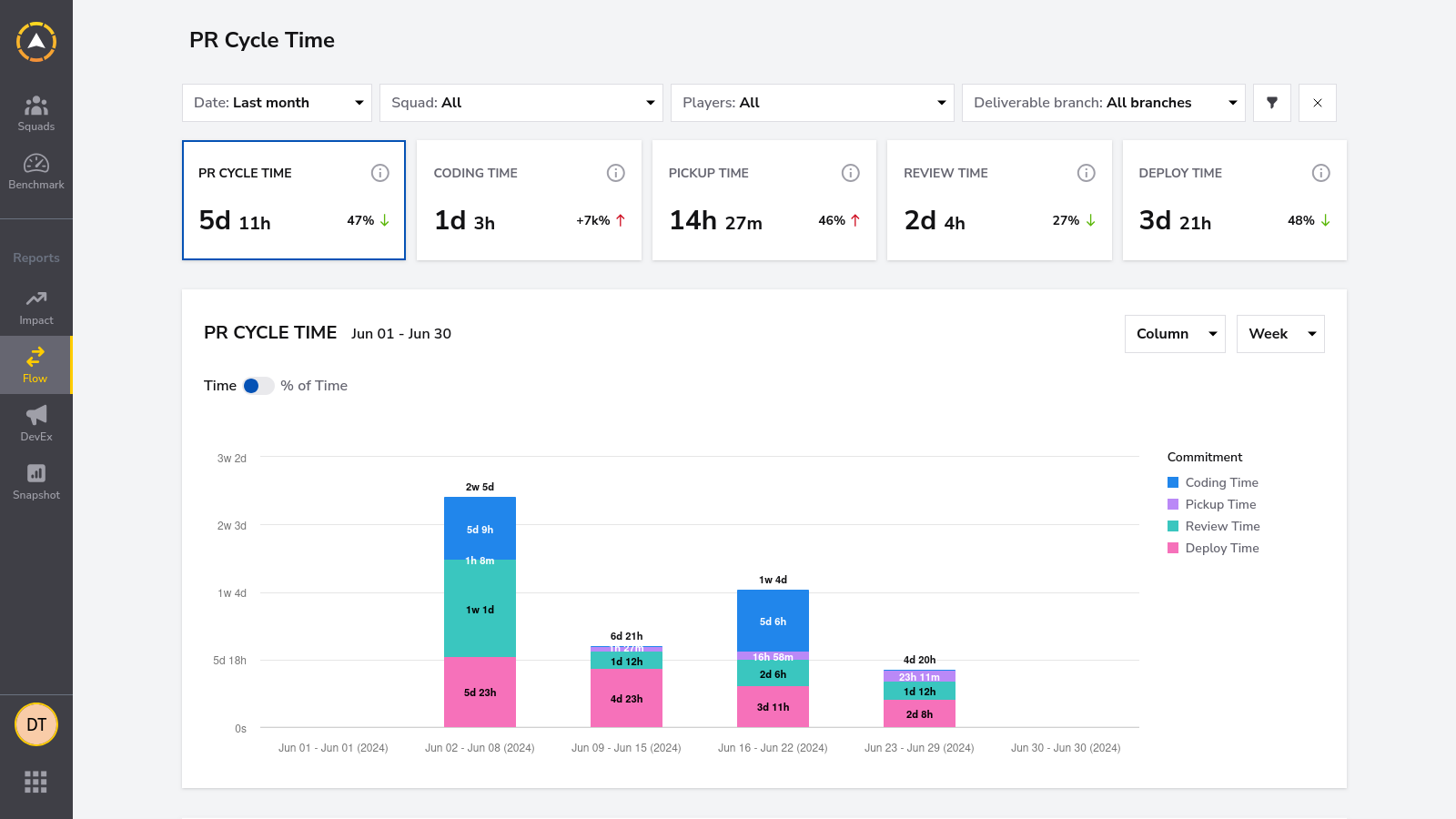
Look for patterns: Is pickup time consistently high? You may need more reviewers or better assignment processes. Is review time long? PRs might be too large, or reviewers might be overloaded. Is merge time slow? There might be manual steps or approval gates that could be automated.
Optimizing Software Development Using Cycle Time
Streamline Code Reviews
Code review is often the biggest contributor to cycle time. Set clear expectations for review turnaround (e.g., first review within 4 hours), distribute review responsibilities evenly, and keep PRs small enough to review quickly.
Implement Automation in Testing and Deployment
Automated testing and deployment pipelines eliminate manual bottlenecks and reduce both cycle time and lead time. Invest in comprehensive CI/CD that gives developers fast feedback on their changes.
Improve Collaboration and Communication
Clear communication about priorities, blockers, and dependencies helps work flow smoothly through the pipeline. Daily standups, clear PR descriptions, and well-defined review processes all contribute to shorter cycle times.
Set Clear Targets for Cycle Time Reduction
Use historical data to set realistic improvement targets. Track progress over time and celebrate improvements. Make cycle time visible to the team so everyone understands its importance and can contribute to reducing it.
Wrapping Up
Lead time for changes and cycle time are complementary metrics that together give you a complete picture of your delivery efficiency. Cycle time helps you optimize the development process, while lead time captures the full pipeline. By measuring and improving both, you can deliver value to users faster and more reliably.