
Code review is the quality control point where bugs are caught, knowledge spreads, and standards are enforced. High-performing teams treat it as a craft—not a checkbox. They build habits that keep reviews fast, thorough, and non-toxic.
This post covers the practices that separate teams who ship with confidence from teams who cross their fingers and hope.
What is a code review and why it still matters
According to Google Engineering Practices, the primary purpose of code review is to ensure code quality and maintainability across the codebase. It is not about proving who is right. It is about making the code better than what the author could produce alone.
Code reviews catch defects before they reach production. They distribute knowledge so no single developer becomes a bottleneck. They enforce consistency, teach junior developers, and keep technical debt visible.
Research from SmartBear's study of Cisco's review practices found that code review can catch 70-90% of defects before they ever ship. The same study showed that review effectiveness drops sharply after about 60 minutes or 400 lines of code. These findings have shaped how elite teams structure their review processes.
Code review best practices
Keep pull requests small
Review performance degrades quickly as PR size increases. Studies consistently show that reviewers find fewer defects per line as PRs grow. The sweet spot is under 400 lines of change. Beyond that, defect detection falls off a cliff.
Small PRs are easier to understand. They get reviewed faster. They are less likely to introduce regressions because the surface area is contained. If something does go wrong, they are easier to roll back.
Break large features into stacked PRs. Each should be independently reviewable and mergeable. A 2,000-line feature becomes five 400-line PRs that move through review in hours instead of days.
Automate style and formatting before a human looks
Do not waste reviewer brain cycles on indentation, variable naming, or import order. Automate it. Run linters, formatters, and static analysis in CI before a human ever sees the PR.
If your CI gates fail, the PR should not be eligible for human review. This removes the social friction of asking someone to fix a missing semicolon. It keeps reviewers focused on logic, architecture, and security—things that actually require judgment.
Tools like ESLint, Prettier, Black, RuboCop, and SwiftLint should be non-negotiable. Add type checking and basic security scanning to the same pipeline.
Require tests as a condition of review
Untested code should not pass review. The question is not "did you write tests?" but "do these tests give me confidence this change works?"
Reviewers should look at test quality, not just test presence. Do the tests cover edge cases? Do they verify the right behaviors? Would they fail if the implementation broke?
PR descriptions should include how the change was tested. Screenshots for UI changes. API responses for endpoint changes. Test output for logic changes. This gives reviewers evidence to work with, not just code to read.
Define clear ownership and approval rules
Ambiguity about who should review what creates delays. Every repository should have clear ownership rules documented in CODEOWNERS or equivalent.
Specify how many approvals are required. One is usually enough for routine changes. Two makes sense for critical paths or security-sensitive code. More than two approvals for standard PRs is a sign of organizational distrust, not engineering rigor.
Document who has merge rights. Make it clear that authors should not merge their own code without review, and that reviewers are responsible for the code they approve.
Use synchronous review for high-risk changes
Not all code can be reviewed effectively async. Security changes, architecture pivots, and complex algorithmic work benefit from synchronous review—pairing or live walkthroughs.
When the stakes are high, schedule a 30-minute session. The author walks through the change, explains the reasoning, and answers questions in real time. The reviewer can probe assumptions, challenge approaches, and suggest alternatives immediately.
Synchronous review is faster for complex changes because the feedback loop is instant. It also builds relationships. The human element matters.
Code review metrics that actually matter
Metrics should diagnose process health, not rank individuals. Track these at the team level to understand where reviews slow down or lose effectiveness.
| Metric | What it tells you | Healthy direction |
|---|---|---|
| Pickup time | Time from PR open to first review | Under 4 hours |
| Review turnaround | Time from first review to approval | Under 8 hours |
| PR size | Lines of change per PR | Under 400 lines |
| Comments per PR | Engagement and thoroughness | 3-10 comments |
| Review coverage | Percentage of PRs that get reviewed | 100% |
| Reviewer load balance | Distribution of reviews across team | Even distribution |
Pickup time measures responsiveness. Long pickup times mean PRs sit idle, context decays, and merge conflicts accumulate.
Review turnaround measures thoroughness. Fast turnaround with zero comments suggests rubber-stamping. Slow turnaround with excessive comments suggests PRs are too large or reviewers are overloaded.
PR size is a leading indicator. Large PRs predict long review times and low defect detection. Track this religiously.
Comments per PR indicates engagement. Too few suggests superficial review. Too many suggests PRs are unfocused or the author and reviewer are not aligned on approach.
Review coverage catches process breakdowns. Any PR merged without review is a failure of the system, not an exception to accept.
Reviewer load balance prevents bottlenecks. If 80% of reviews come from one person, your bus factor is one and that person is probably burning out.
Why is cycle time the most important metric
Code review best practices in 2026 and the impact of AI
AI coding tools changed the volume equation. Developers write code faster with Copilot, Cursor, and Claude Code. This means more PRs, more changes to review, and higher risk if review quality drops.
The teams adapting best to AI-assisted development are doubling down on review discipline:
-
Size discipline is non-negotiable. AI generates code fast. Resist the temptation to ship 1,000-line generated changesets. Break them down. Review them incrementally.
-
Author accountability increases. When code is AI-generated, the human author is still responsible for understanding, testing, and defending every line. Reviewers should hold authors to this standard.
-
Synchronous review for AI-generated architecture. When AI suggests structural changes, review them live. The reasoning behind the architecture matters more than the code itself.
-
Rework tracking becomes essential. AI-generated code often needs refinement. Track how much time teams spend fixing AI-generated code versus hand-written code. This reveals where AI helps versus where it creates debt.
AI does not replace code review. It makes review more important. The bottleneck shifts from writing code to validating it. The teams that win will be the ones with rigorous review processes that scale with AI-generated volume.
How DevStats helps you improve code review
DevStats is an engineering intelligence platform that gives you visibility into your code review process without the surveillance feel. It connects to GitHub, GitLab, Azure DevOps, and Jira to surface metrics that matter.
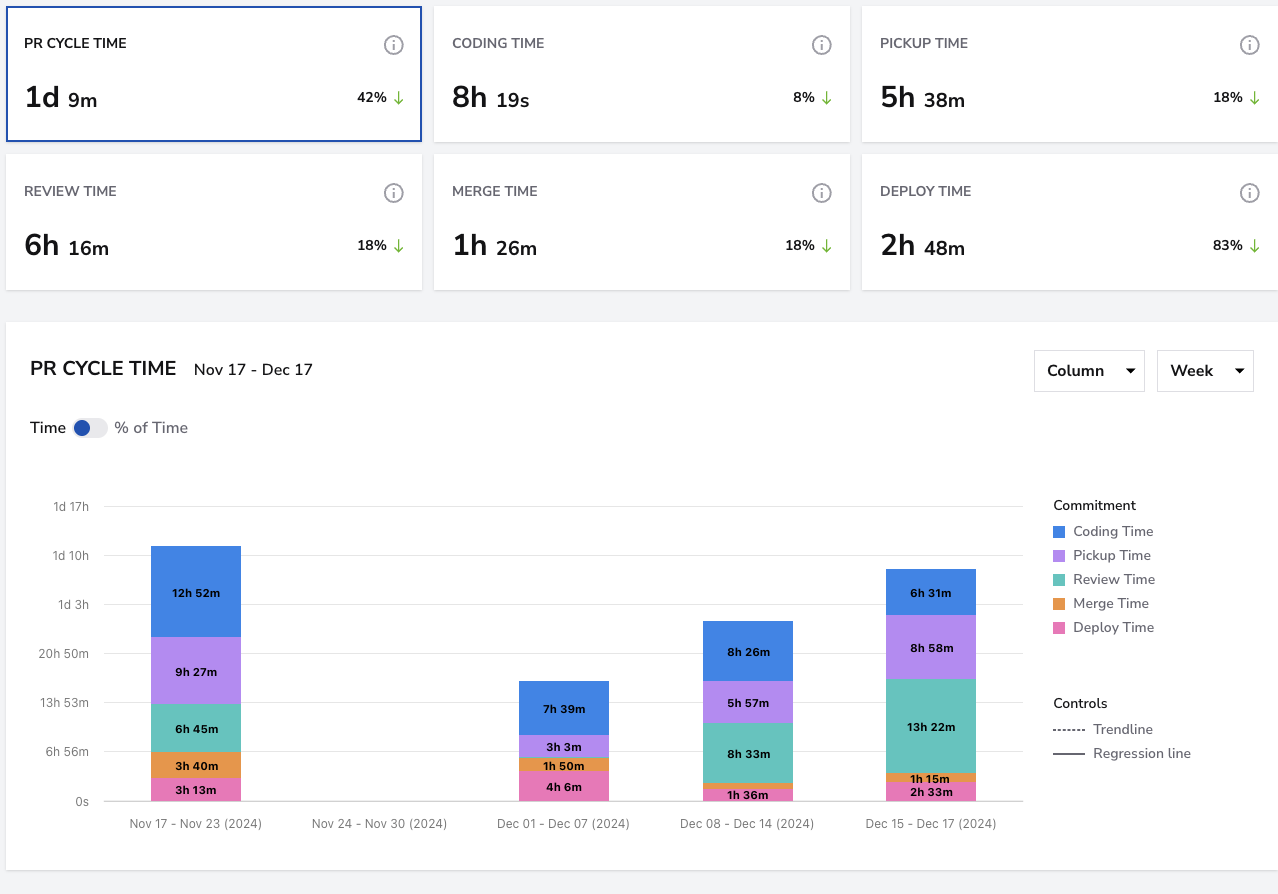
You get PR cycle time breakdowns that show exactly where reviews stall. Pickup time, review time, and deployment time are tracked separately so you can target interventions.
Review coverage and reviewer load balance reports show whether reviews are distributed fairly or falling on the same few shoulders. Comments per PR trends help you spot when reviews get superficial.
All metrics are at the squad and workflow level. No individual rankings. No leaderboard gamification. Just process visibility that helps you improve how work moves through your system.
See where your reviews slow down
Slow reviews kill momentum. A PR that sits for two days waiting for feedback costs more than the time itself—it costs context, focus, and team morale.
DevStats shows you exactly where reviews stall. Is it pickup time? Review thoroughness? Deployment delays? You cannot fix what you cannot see.
Start measuring your code review process today. Get baseline data, set targets, and track improvement. Your team will ship faster with higher quality and less frustration.
Frequently asked questions
What makes a good code review?
A good code review catches defects, shares knowledge, and improves the code without destroying morale. It happens promptly—within hours, not days. It focuses on architecture, logic, and security, not style issues that linters should catch. It balances thoroughness with pragmatism. And it treats the author as a partner, not an opponent.
How long should code review take?
First review should happen within 4 hours of PR opening. Total review turnaround—from open to approval—should be under 8 hours for routine changes. Complex changes or those requiring multiple review rounds might take 24 hours. Anything longer suggests PRs are too large, reviewers are overloaded, or the process is broken.
What code review metrics should teams track?
Track pickup time, review turnaround, PR size, comments per PR, review coverage, and reviewer load balance. These six metrics diagnose the health of your review process without surveilling individuals. Measure them at the team level and focus on trends, not single data points.
How should teams review AI-generated code?
Review AI-generated code with heightened scrutiny. The author is responsible for understanding every line, even if they did not write it manually. Require smaller PRs for AI-generated changes. Use synchronous review for architectural changes suggested by AI. Track rework rates on AI-generated code separately to understand where it helps versus where it creates debt. Never assume AI-generated code is correct—verify it.